The Socialisation Window: The Weeks That Shape the Adult Dog
There is a window early in a puppy's life when the brain is unusually ready to file new things as normal. What goes in during those weeks needs less repetition and sticks harder than anything learned later. It closes gradually, and it does not reopen.
What socialisation actually means
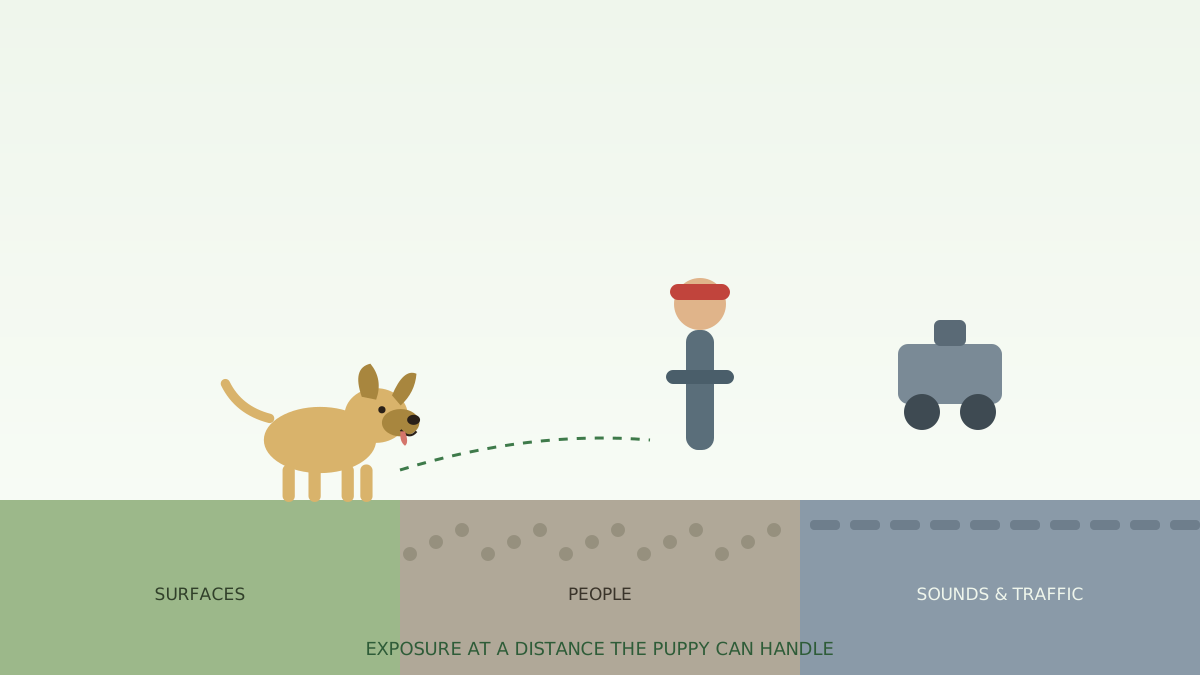
It is not a queue of strangers taking turns to cuddle a puppy, and it is not a free-for-all in a park. It is controlled exposure at a distance the puppy can handle, paired with good things, ending before the puppy is overwhelmed. A puppy that watches a skateboard from twenty metres while eating chicken is being socialised. A puppy pinned by a skateboard passing at arm's length is being frightened.
The list is longer than dogs
Most people socialise puppies to other dogs and stop. The adult problems that fill behaviour clinics come from the rest of the list: surfaces (grates, tiles, gravel, stairs), sounds (traffic, vacuum, fireworks at low volume), handling (paws, ears, collar holds), people (hats, beards, sticks, children, wheelchairs), and being alone, in short, calm increments.
Vaccination is not a reason to wait
Waiting until a puppy is fully vaccinated wastes most of the window. Carry the puppy, use clean private gardens, sit in the car with the window down and watch a street, invite healthy vaccinated adult dogs to your home. Veterinary and behaviour bodies broadly agree that the risk of an under-socialised adult outweighs a carefully managed exposure period, but discuss your local disease risk with your own vet.
Watch the puppy, not the checklist
Retreating, freezing, tail tucking, refusing food it would normally eat — these mean you are too close or it is too much. Increase distance, lower intensity, let the puppy approach in its own time and reward it for choosing to look and then look away. Forcing a frightened puppy forward creates exactly the adult you were trying to prevent.
Adolescence undoes the complacent
Between roughly six and eighteen months many dogs become newly suspicious of things they accepted as puppies. This is normal development, not failed socialisation. The answer is the same method again — distance, good associations, patience — rather than assuming the early work was wasted.
What a good exposure session actually looks like
The image most people have of socialisation is a puppy in the middle of a crowd being handled by strangers. That is not socialisation; it is flooding, and it produces exactly the adult dog the exercise was meant to avoid.
A good session is dull to watch. The puppy sits on a bench with you, forty metres from a market, and observes. It notices the noise, looks, and looks away. You do nothing except be there and occasionally hand over something good when the puppy chooses to watch. If the puppy stops taking food, the distance is wrong and you move further back. If it approaches something on its own and then returns to you, that is the whole exercise working — the return matters more than the approach. Five to ten minutes is a session. Two short ones in a week, in six different settings, beat one exhausting afternoon.
Keep a written list of what the puppy has met: surfaces, sounds, vehicles, people of different appearance, other species, being alone in a room. Written down, the gaps become obvious, and the gaps are where adult fears usually come from.
Frequently Asked Questions
When is the socialisation period?
Roughly the first three to four months of life, with the most sensitive weeks early in that span. Exposure remains valuable afterwards, but it takes more work.
How can I socialise before vaccinations are complete?
Carry the puppy, use your own garden, invite healthy vaccinated dogs to visit, and drive to quiet places to watch the world without walking on high-traffic ground.
Is more exposure always better?
No. Quality matters more than quantity. One calm, positive experience beats five overwhelming ones, and a frightened puppy learns fear rather than confidence.
Is it too late if my dog is already an adult?
No, but the work is different. An adult learns new associations more slowly and needs smaller steps and more repetitions. The window closing does not mean the door is locked; it means the easy period has passed.
Should I let strangers pet my puppy?
Only if the puppy chooses to approach and can leave freely. Being held still while unfamiliar hands arrive teaches a puppy that people remove its options, which is the association that later produces avoidance.
Sources & Further Reading
- American Veterinary Society of Animal Behavior — puppy socialization position statement — avsab.org
- The Kennel Club — puppy advice — www.thekennelclub.org.uk
Last updated: 10 August 2026