Loose Lead Walking: Why Pulling Works, and How to Make It Stop Working
Nobody teaches a dog to pull. The dog works it out, because from its point of view the evidence is overwhelming: tighten the lead and the world comes closer. Every walk where that happens is another repetition of a lesson you did not intend to give.
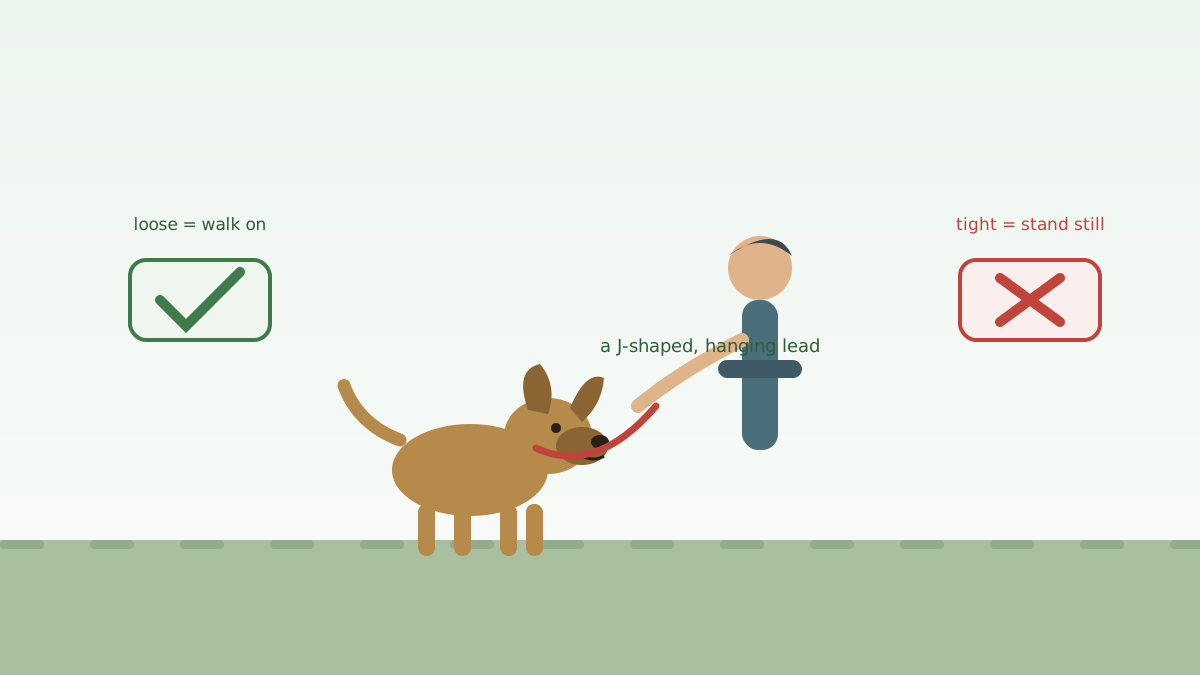
Change what pulling produces
The core of every effective method is the same: a tight lead stops forward progress, a loose lead restores it. When the lead goes taut, stop and stand still. Say nothing. The instant the lead softens — the dog looks back, takes a step towards you, or simply relaxes — mark it and move off again.
The first few sessions of this are tedious and you will cover almost no ground. That is the method working, not failing. The dog is discovering that the old strategy has stopped paying.
Reward the position you want
Stopping alone tells the dog what does not work. It does not say what does. Feed generously at your side, at the height of your knee, while the dog is walking there — that is the position you are actually paying for. Many owners only give attention when the dog is already at the end of the lead, which teaches the opposite of the goal.
Start where success is possible
Practise in a hallway, then a garden, then a quiet street, before attempting the route past the park. A dog cannot learn a new skill in the environment where the old habit is strongest. If a walk has to happen before training is finished, treat it as a separate activity — use a longer line, accept some pulling, and do not undo the training sessions by mixing the two.
Equipment: helpful, not curative
A well-fitted Y-shaped harness keeps pressure off the throat and is generally preferred, especially for dogs that lunge. Front-clip attachments reduce leverage. What none of these do is teach anything: they buy control while training happens. Equipment that works by causing pain or discomfort suppresses pulling without teaching an alternative, and is increasingly rejected by professional bodies.
Meet the underlying need
Some pulling is simply an under-exercised, under-stimulated dog with one hour of freedom per day. Adding sniffing time, a long line in safe open space, and letting the dog choose the direction for part of the walk lowers the desperation that drives the pulling in the first place.
Equipment: what changes the physics and what does not
No harness trains a dog, but the wrong attachment point makes the job harder than it needs to be. A flat collar puts pressure on the throat exactly where a pulling dog is least sensitive to it, and it gives the handler nothing to work with except force.
A well-fitted Y-shaped harness with a front attachment changes the geometry: when the dog moves ahead, the line turns it gently back towards you rather than letting it lean into the pressure. That turn is not a correction and it should not be used as one — it simply removes the mechanical advantage the dog gets from pulling straight ahead. Two clips, one at the chest and one at the back, give the smoothest handling. Length matters as much as the harness: a fixed lead of about two metres allows a dog to move without teaching it that tension is constant, while a retractable lead teaches the opposite, because it is under tension by design.
Anything that works by causing pain, pressure on the throat or a startle is outside what this site recommends, for reasons set out in the editorial policy.
Frequently Asked Questions
Why does my dog pull on the lead?
Because it works. Pulling has always moved the dog closer to whatever it wants, and every walk in which that happens reinforces the habit.
Is a harness better than a collar?
A well-fitted harness spreads pressure away from the neck and is generally kinder, particularly for dogs that lunge. No equipment trains loose lead walking by itself.
How long does it take to fix pulling?
Weeks rather than days for an established habit, because you are competing with hundreds of previous walks in which pulling succeeded.
How long does loose lead walking take to teach?
There is no fixed answer, and anyone who gives you one in days is guessing. What is predictable is the pattern: the first improvements appear in quiet places within a week or two, and difficult environments take considerably longer because the dog has practised pulling there.
What do I do when the dog is already pulling?
Stop moving. Wait for any slack — a head turn, a step back, a shift of weight — then mark it and move again. The walk resuming is the reward. Dragging the dog back or yanking the lead teaches nothing except that the lead is unpleasant.
Sources & Further Reading
- Dogs Trust — training and behaviour advice — www.dogstrust.org.uk
- Blue Cross — pet advice and training — www.bluecross.org.uk
Last updated: 10 August 2026